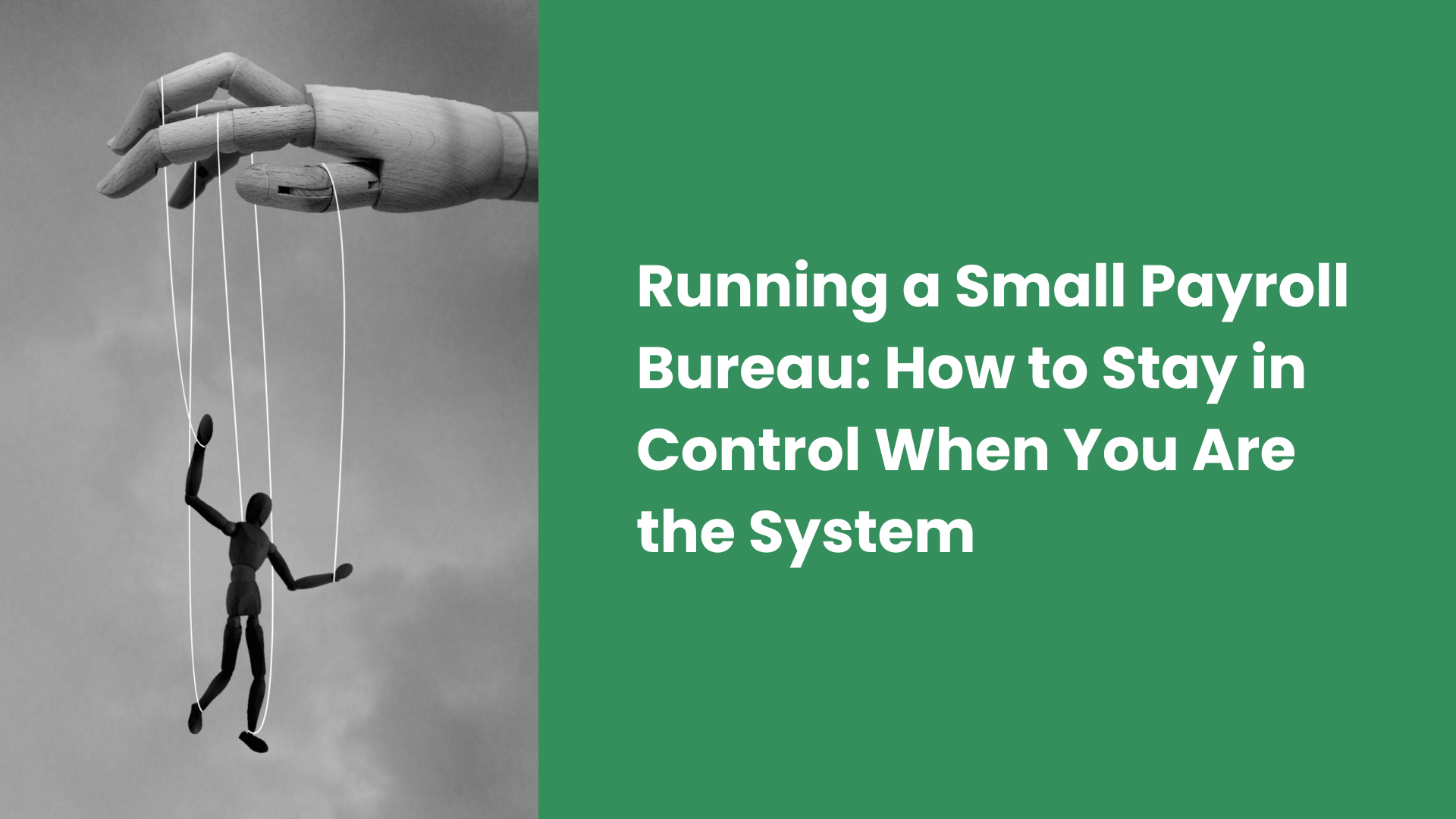
You are not just the manager. You are the system.
Ask the manager of a small payroll bureau where the operation is tracked, and the honest answer is usually the same. Some of it is in a spreadsheet. Some of it is in the inbox. And the rest of it, the part that actually holds everything together, is in their head.
You know which client always sends changes late. You know that one payroll has a quirk with pension contributions that only you and one other person understand. You know, roughly, who on the team is stretched this week. Nobody wrote any of this down. It works because you are there.
That is the reality of small payroll bureau management. In a team of six, ten, or fifteen people, the manager is not overseeing the system. The manager is the system.
Nothing broke. It just accumulated.
No small bureau designs itself this way. In the early days, with a handful of clients, holding everything in your head was genuinely the most efficient option. A quick word across the desk covered what a workflow tool covers in a bigger firm.
Then the client list grew. The team grew a little. The cycles multiplied, weekly, fortnightly, four-weekly, monthly, each with its own cut-offs and BACS windows. The spreadsheet gained tabs. The inbox gained folders. And the gap between what the systems record and what you personally carry got wider every year.
The work is still accurate. Clients are still happy. But the operation now depends on one or two people being present, healthy, and never distracted. That is not a system. That is a single point of failure with a job title.
The real cost of being the system
Interruptions become the job
When status lives in your head, every question routes through you. Is the Hartley payroll done? Did the new starter forms come in? Who is covering the weekly run on Thursday? Each interruption is small. Twenty of them a day means you process payroll in the gaps between being a human status board.
You can never fully switch off
Holidays are covered on paper. In practice, you check your phone at the airport, because you know the operational picture is not written down anywhere. The bureau runs on your availability, and that has a cost your accounts will never show: your own capacity, and eventually your own resilience.
The bureau cannot grow past you
There is a hard ceiling on any operation that routes through one person. You can add clients, but every one of them adds weight to the same point. Small bureaus rarely hit a wall because the team cannot process more payrolls. They hit a wall because the person holding the operation together cannot hold any more.
What control actually looks like in a small bureau
Control does not mean more effort. It means the knowledge and status you carry moving out of your head and into something the whole team can see.
It looks like every payroll broken into visible steps, so anyone can see what is done, what is next, and what is late without asking you. It looks like deadlines and cut-offs scheduled around real payroll cycles, surfacing risk days early rather than the morning of. It looks like a live picture of the operation that is accurate at 10am on any given day, whether you are in the office or on a beach.
None of this requires replacing the payroll software you trust. Changepen works alongside Sage, Star, BrightPay, IRIS, Moneysoft and others, as the operational layer built for payroll bureaus rather than adapted from generic project tools.
Small bureau, professional infrastructure
There is a persistent assumption that operational platforms are for the big firms. The opposite is closer to the truth. A firm of two hundred can absorb a key person being away. A bureau of ten cannot. The smaller the team, the more valuable it is that the operation lives in a system rather than a person.
You built a bureau that clients trust. The next step is a bureau that runs with you, not through you.
Curious where your own operation stands? Take the two-minute Payroll Service Quiz and see how your bureau compares.