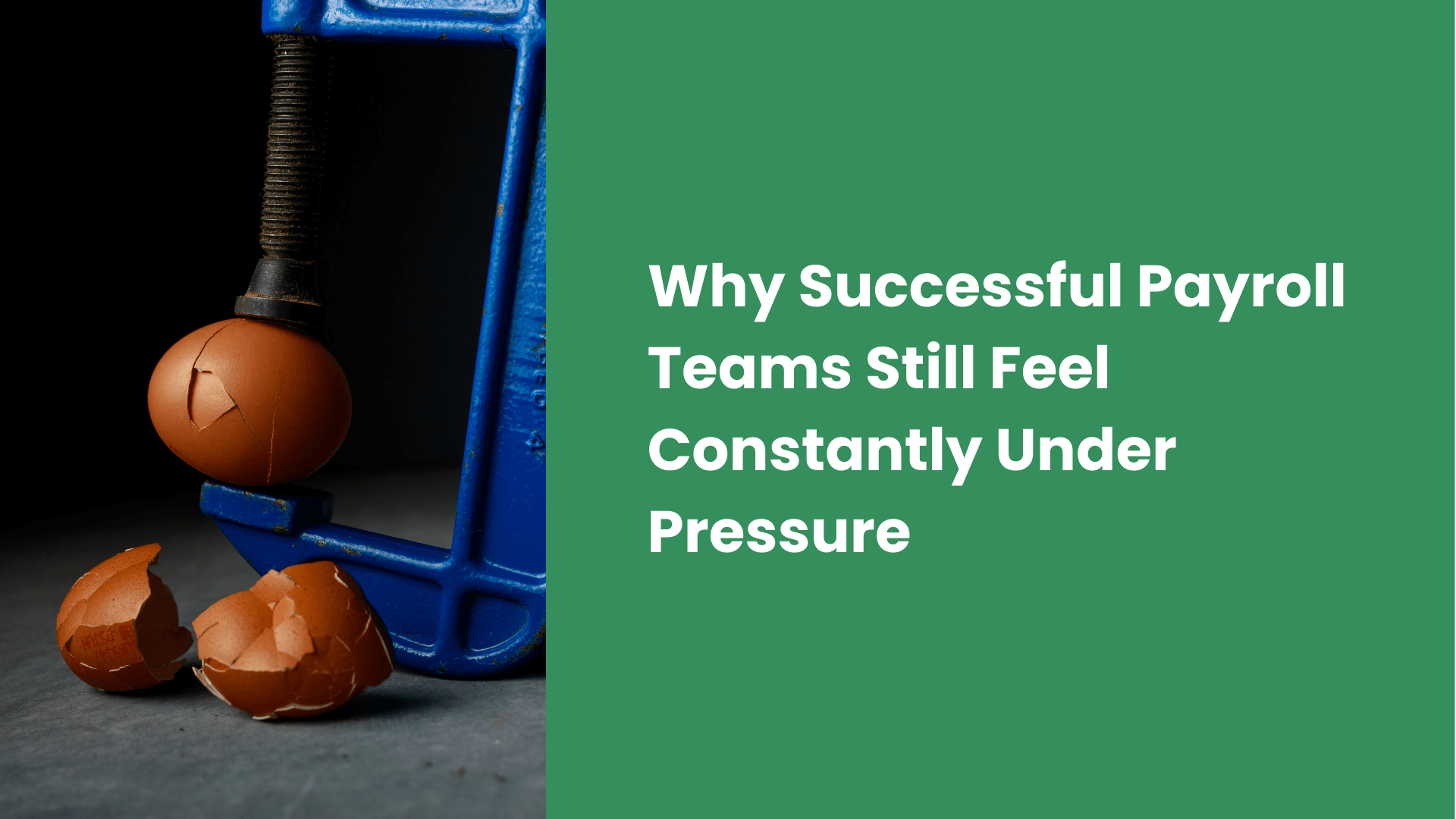
You can be doing everything right in payroll and still feel like you are constantly one step behind.
If you run an outsourced payroll service, this may feel familiar.
- Your payrolls are accurate.
- Your clients are paying.
- Your team knows what they are doing.
And yet, every payroll period feels intense.
There is always something to chase.
Someone to double-check.
A question that arrives later than it should.
A small issue that absorbs far more time than it deserves.
Even on good months, the pressure never quite lifts.
This is not a sign that your payroll service is struggling.
In fact, it is often a sign that it is doing well.
When Payroll Success Starts to Feel Harder, Not Easier
Most Heads of Payroll expect that experience brings calm.
As teams grow more confident, systems mature, and client bases stabilise, the assumption is that things should get easier. And in some ways, they do. Payroll accuracy improves, edge cases become familiar, and mistakes reduce.
But something else happens quietly alongside that success.
Growth adds layers.
More clients means:
- More payroll frequencies
- More pay structures
- More exceptions
- More deadlines to juggle
Even if each individual payroll is well understood, the overall operation becomes harder to see and control.
The work still gets done.
It just takes more effort to hold everything together.
Accuracy Is Not the Same as Control
Payroll professionals are trained to be precise.
Calculations must be right.
Deadlines must be met.
Compliance must be maintained.
These are non-negotiable, and payroll teams are exceptionally good at delivering them.
But running a payroll service is about more than accuracy.
It is about knowing:
- Which payrolls are on track
- Which are waiting on information
- Where the real risks are this week
- Who in the team is under pressure — and who is not
When that visibility is missing, leaders rely on instinct, experience, and constant checking.
The service holds together, but it does so through vigilance rather than clarity.
That is exhausting over time.
The Invisible Work No One Plans For
A large part of payroll work never appears in timesheets or reports.
It is the work between the work:
- Chasing missing information
- Searching inboxes for the latest version
- Clarifying vague client requests
- Answering “quick” questions that interrupt focused processing
- Reconstructing decisions after the fact
None of this feels dramatic on its own.
But together, it creates a constant low-level pressure that drains time and attention - especially during peak periods.
This work grows as services grow.
And because it is invisible, it is rarely addressed directly.
Why This Pressure Is Not a Personal Failing
When payroll feels constantly pressured, leaders often internalise it.
They assume they need to be:
- More organised
- More decisive
- More available
They step in to absorb complexity so their teams can keep moving.
But this pressure is not caused by a lack of competence or commitment.
It is structural.
Most payroll services evolve using tools and processes that were never designed to manage payroll as an operation. Over time, people compensate. They remember more. They check more. They work harder.
That works ... until it does not.
Good teams can mask operational gaps for a long time.
But the cost is carried by the people holding everything together.
Naming the Real Problem
If your payroll service feels successful but constantly intense, you are not alone.
This experience is common in growing outsourced payroll teams, especially those delivering high-quality work without the operational visibility to support it.
The solution is not:
- Working harder
- Better people
- One more spreadsheet
It starts with recognising that payroll success brings complexity and that complexity needs structure.
In the coming weeks, we will explore:
- Why email becomes a hidden bottleneck in payroll operations
- Why generic tools struggle to support payroll teams
- What real visibility looks like in a modern payroll service
Not to sell you something but to give language to a problem many payroll leaders quietly carry.